Democracy means rule of the people by the people - which means, a flourishing democracy consists of both a strong state government, and a robust civil society and active citizenry. Here’s how it really works currently:
To empower citizens against corruption and lapses in governance, India passed a “Right to Information (RTI)” act that gives citizens the right to demand almost any government information. While this move has liberated activists to a point, and have also spurred activism in citizenry, the demands have also resulted in a rise in political threats and murders of common people.
Amit Jethwa had just left his lawyer’s office after discussing a lawsuit he had filed to stop an illicit limestone quarry with ties to powerful local politicians. That is when the assassins struck, speeding out of the darkness on a roaring motorbike, pistols blazing. He died on the spot, blood pouring from his mouth and nose. He was 38.- New York Times (NYT)
Activists like Mr. Jethwa used this act to a higher extent than most, by making pointed inquiries (and collected information enough for a lawsuit) about the intersection of vast businesses and politics - and paid dearly for his belief in the rule of law and social justice. The fact is that though India is supposed to be the world’s largest democracy, it is still torn between democratic principles and feudalistic practices. The government and those holding public duties still treat the public as subjects rather than as people they are representing, lording over them in a clientalistic manner. So much so that there have been deep political backlashes ever since the RTI act was introduced as a leveler between people and the state.
The Congressman said to be responsible for Mr. Jethwa’s death is a key kingmaker in Gujarat politics, who, despite strong evidence and public uproar, still walks free. Mr. Jethwa, after multiple assaults and death threats, had even written to the chief minister in 2008, implying that the congressman should be held responsible if he is to be harmed in the future regarding this dispute. Yet the police never bothered to investigate his involvement in the case, and refused to comment on why they had not investigated.
“Our hearts are broken after his death,” Mr. Socha (a fellow activist) said. “You cannot fix the system. Everybody is getting money. If I give my life, what is the point?”- NYT
So I wonder, why is India, with its almost bumbling but stifled civil society and a pathetic government, known as a democracy?
How about the United States?
The US, I would argue, has become too capitalist for democracy to even exist, let alone thrive, in the American Society. Governance in the States has as its principal duty to serve the corporations and the market before the common person. All those Americans who like to wax lyrical about freedom of speech and expression, and about how it’s fundamental to a citizen’s happiness - to what end I ask? How much power does the average Joe have in determining his future in the country?
Not much really. For example, Walmart recently announced that it would be cutting down the calories, fat, sugar, and sodium in its foods in the next 5 years - to make it easier for its customers to embrace healthy lifestyles. Many nutritionists espoused that this Walmart intervention would be more powerful than federal regulations.
I think the above example is too hopeful an example - A better one to illustrate the failings of American democracy would be the direction of the congress towards the end of the last year. (On the other hand, I am not going to talk about the health coverage bill, because that’d be too blatant already.)
After condemning the budget deficits caused by federal spending and taxation that Democrats proposed, Republicans outlined a policy agenda built on extending the Bush tax cuts for the super rich, which would add a whooping $700 billion more to national debt than Obama’s tax proposal (budget deficits are a terrible thing, so let’s make them bigger). Yet, this bill passed congress. Immediately afterwards, Republicans blocked a bill to provide medical coverage for 9/11 responders on the premise that it would add more to the national budget deficit. In reality, funding for this bill was actually proposed to come from closing tax loopholes in the system (literally a win-win situation). This bill however, only passed with the reduction in spending, after fierce criticism from the Media.
Though one might point out that open media, arguably the invisible arm of democracy, was what that made sure democratic principles were adhered to by the state in the last case, I would like to highlight that that above mentioned guard dog in the media consisted of just Jon Stewart. The rest were off frolicking to the tunes of sensational headlines and corporal messages - even Fox news ignored the 9/11 responders bill, after almost a decade of using 9/11 justice as its tagline.
Then there is Singapore - with one of the strongest governments that I have studied, coupled with a rather immature civil society and extreme social inequalities (No.2 in the world). For example, at least three generations of Singaporeans have passed through the public education system, having been constantly indoctrinated with messages of racial and religious harmony. Yet the civil society still remains finely divided on racial lines, expecting state intervention and policing of racial sensitivities, without even attempting to take any effort on its own.
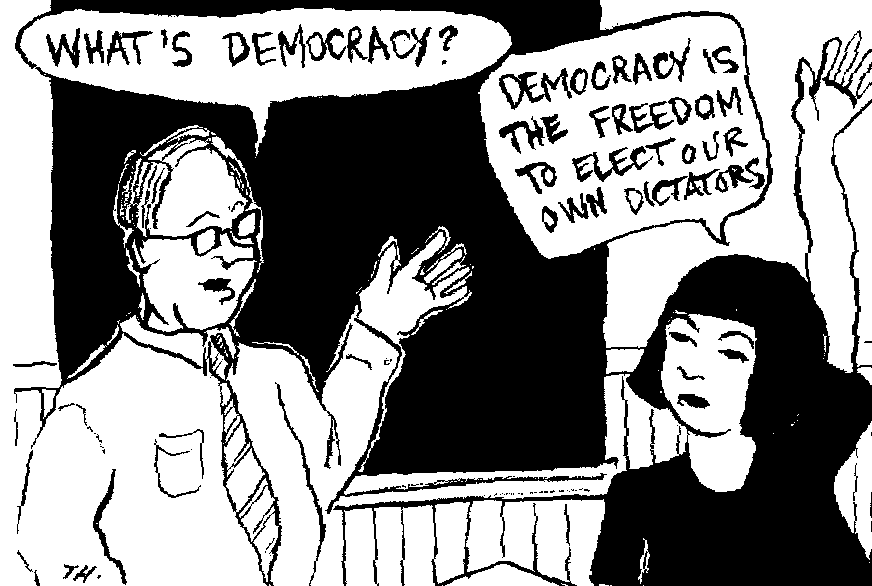
All these are democracies, in one way or another - semi, full, large, ultimate - whatever. Yet, democracy, as it is fundamentally understood to be, has failed in every one of them. The common man, in these countries, living at the lower echelons of the society, literally has little access and power to further his own welfare and be part of his society’s future.
Honestly, is democracy really too much of an ideal to look up to?


